Mentorship • Higher Education • Academic Leadership
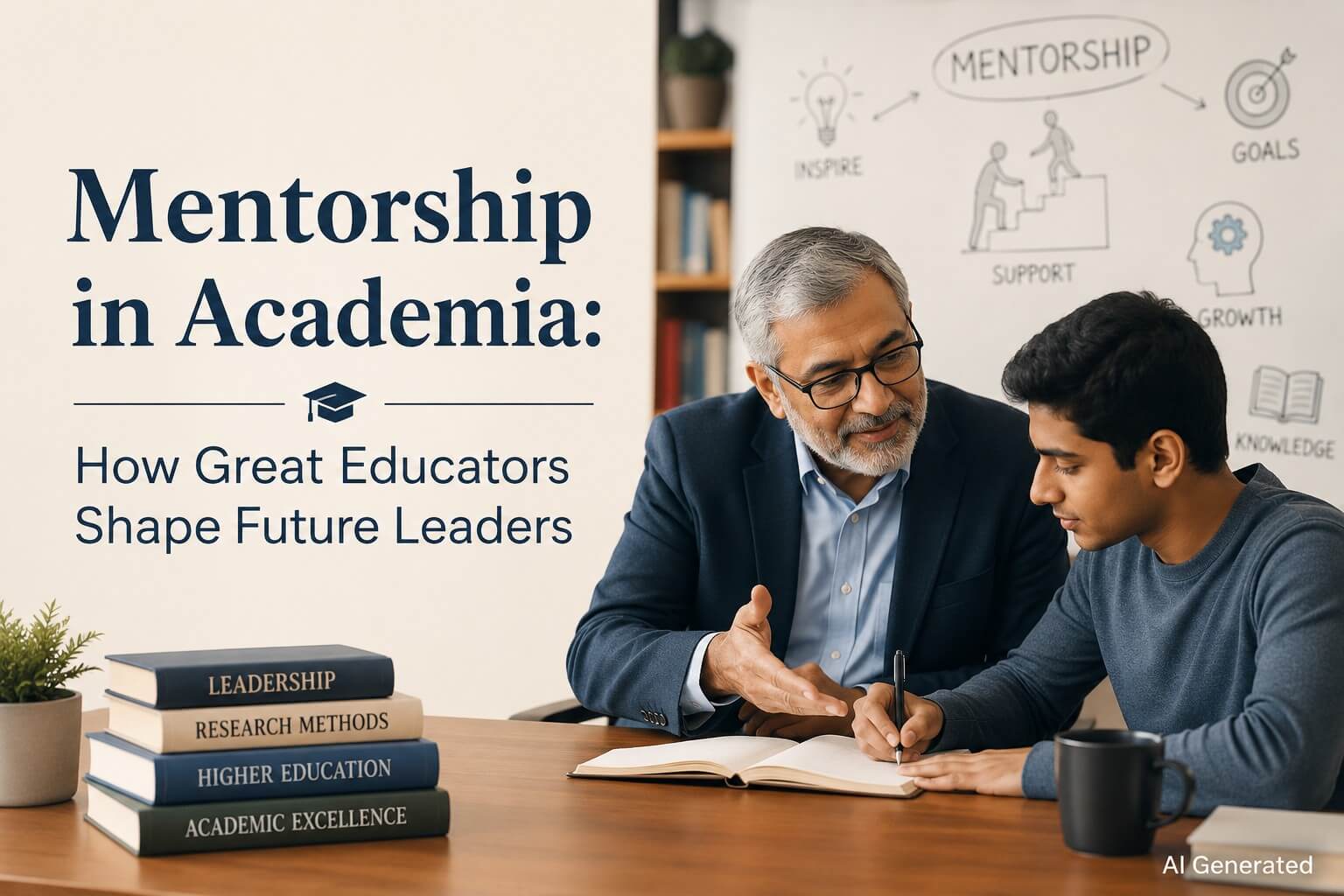
Mentorship in Academia: How Great Educators Shape Future Leaders
On the timeless art of guiding minds — and why the best teachers leave marks that outlast any classroom.
"The mediocre teacher tells. The good teacher explains. The superior teacher demonstrates. The great teacher inspires."
— William Arthur Ward
INTRODUCTION
A Relationship That Rewrites Destinies
Behind nearly every great leader, scientist, artist, or thinker stands a mentor — a figure who saw potential where the individual could not yet see it themselves. In academia, this relationship is not merely transactional; it is transformational. It is the quiet force that turns curious students into confident pioneers.
Mentorship in the academic world is as old as scholarship itself. From Aristotle guiding Alexander the Great to Marie Curie inspiring generations of women in science, the mentor-protege bond has been a primary conduit through which knowledge, courage, and vision are passed from one generation to the next. Yet for all its historical weight, mentorship remains one of the most underappreciated engines of human achievement.
Studies show that students who report having a meaningful mentor in their academic career are twice as likely to pursue advanced degrees — and significantly more likely to describe their work as purposeful.
THE CORE
What True Academic Mentorship Looks Like
It is easy to confuse mentorship with instruction. A teacher delivers content; a mentor shapes character. The distinction is crucial. Great academic mentors do not simply transfer information — they cultivate the intellectual habits and moral frameworks that allow students to think, question, and lead independently.
True mentorship unfolds across four essential dimensions:
01. Intellectual Provocation
Great mentors do not hand over answers. They pose questions that force students to stretch — to sit with uncertainty until clarity emerges through their own reasoning.
02. Emotional Investment
The best educators learn who their students are — their fears, ambitions, and blind spots — and respond with empathy as much as expertise.
03. Honest Feedback
Mentorship without candour is flattery. The most formative guidance often stings in the moment and illuminates for a lifetime.
04. Opening Doors
Mentors actively sponsor their students' growth — making introductions, advocating for opportunities, and signalling: this person is worth your attention.
"A great mentor doesn't build followers. They build other leaders — people who will, in turn, shape the minds of the generation that follows."
WHY IT MATTERS
The Ripple Effect of One Great Educator
The impact of a single exceptional mentor is rarely contained to a single student. When an educator invests deeply in one person's growth, that person carries those lessons forward — into their own teaching, leadership, parenting, and professional life. The influence multiplies exponentially across decades.
Consider the genealogy of Nobel Prize winners: research has consistently found that laureates are disproportionately likely to have trained under previous Nobel Prize winners. The transmission is not simply of skills or knowledge — it is of a way of seeing, a standard of rigour, and a belief in what is possible.
The qualities that define a leader-making mentor:
- They believe in the student's potential before the student does.
- They model intellectual humility and question their own assumptions aloud.
- They celebrate curiosity more than correctness.
- They set high expectations and provide the scaffolding to reach them.
- They remain present through failure — not to rescue, but to steady.
- They give credit generously and share authorship of success.
THE CHALLENGE
When Academia Falls Short
For all its celebrated history, academic mentorship is not universally practiced — or practiced well. Many students, particularly those from underrepresented backgrounds, report navigating their entire university careers without a single meaningful mentoring relationship.
The structural demands of modern academia — the relentless pressure to publish, secure grants, and serve on committees — can crowd out the slow, unhurried work of genuine mentorship.
Institutions that treat mentorship as a cultural priority consistently produce more innovative research and more resilient graduates. Mentorship is not a soft extra; it is a strategic investment.
LOOKING FORWARD
Building a Culture of Mentorship
The great educators throughout history did not simply appear. They were themselves mentored — and then, in turn, chose to give what they received. Mentorship is a culture, not an innate gift, and cultures can be built deliberately.
Academic institutions have both the opportunity and the obligation to cultivate this culture by training faculty in mentoring skills, creating formal support systems, and celebrating educators who invest deeply in student development.
For educators themselves, the invitation is simple yet profound: to ask not merely what students are learning, but who they are becoming.
The Longest Classroom
The greatest educators know that the real measure of their work is not found in exam scores or citation counts. It is found decades later — in the choices their students make, the leaders they become, and the mentors they, in turn, choose to be.
The classroom has walls and a semester end. Mentorship does not. Its influence echoes through every decision a student makes long after the last lecture fades. That is the extraordinary, quiet power of the great educator — and it is a power worth protecting.
 WhatsApp | Impact Factor: 7.89