3 Minutes to read
Category: Education, AI and Education
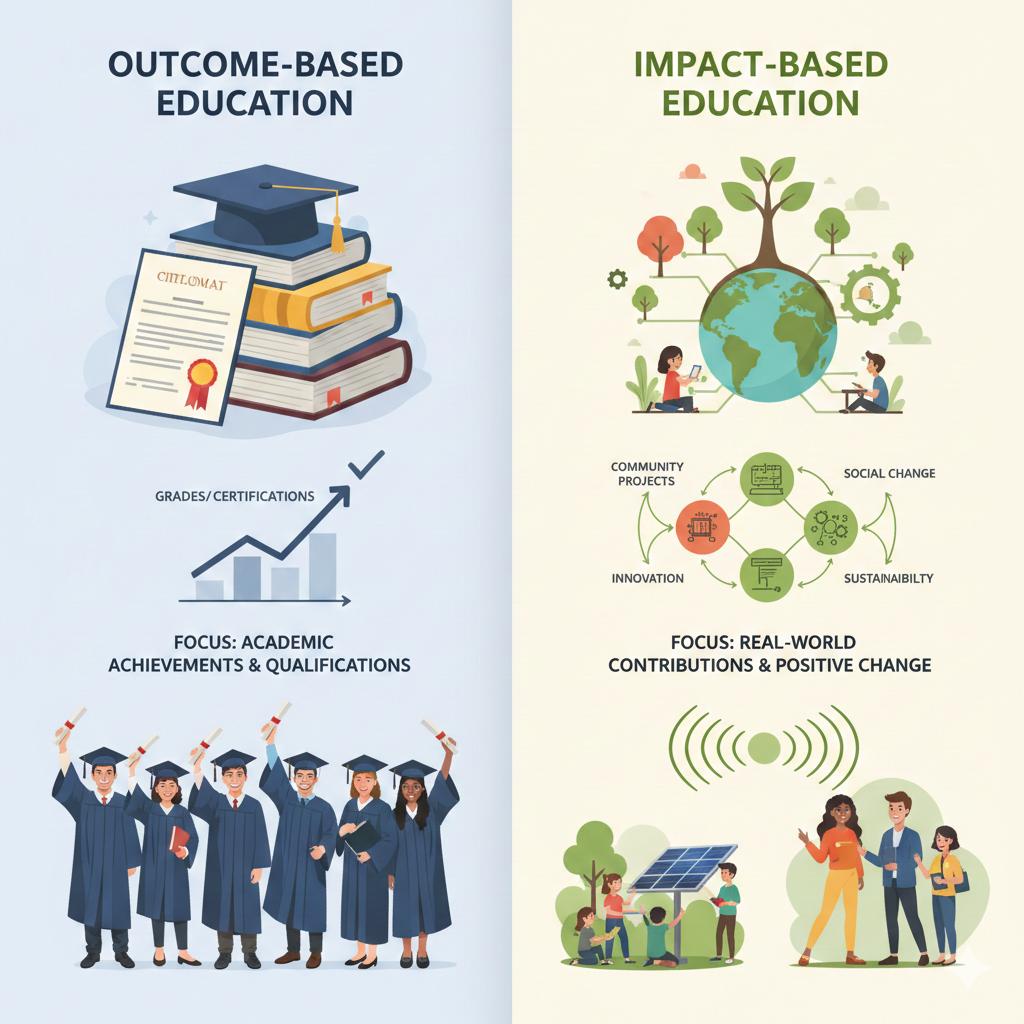
Over the past two decades, Outcome-Based Education (OBE) has helped higher education institutions (HEIs) shift from content-driven instruction to a competency-driven model. Through structured outcomes (COs, POs, PSOs), rubric-based assessments, and accreditation frameworks (NBA, NAAC, ABET), OBE improved teaching–learning processes, standardization, and accountability across institutions. However, global social, technological, and economic changes now demand an educational approach that extends beyond measuring learning competencies.
Rationale for the Shift
While OBE measures whether students acquire skills, it does not measure whether those skills translate into real-world contributions. In the current landscape, employability, innovation, entrepreneurship, research translation, and societal value creation have become increasingly important indicators of educational success. With rapid automation and the rise of AI, the differentiator is no longer skill possession alone, but the ability to apply those skills to generate meaningful impact.
Impact-Based Education (IBE) reframes the central question of higher education from “What can the student do?” to “What change can the student create?” This shift expands educational outcomes toward:
-
Innovation and intellectual property
-
Industry and startup engagement
-
Community and societal impact
-
Employment and career outcomes
-
Sustainable and responsible practices
-
Research-to-application ecosystems
Where OBE demonstrates competency, IBE demonstrates contribution and value creation.
Alignment with National & Global Trends
IBE aligns with evolving expectations from:
-
Industry: seeking graduates who can deliver outcomes, not just hold degrees
-
Accreditation: evolving from outcomes → performance → impact indicators
-
NEP 2020: emphasizing multidisciplinary learning, internships, innovation, and entrepreneurship
-
AI-driven transformation: prioritizing initiative, innovation, and real-world relevance
-
National priorities: supporting pathways toward Viksit Bharat 2047 through human capital development
Proposed Transition Path for HEIs
A phased institutional roadmap is emerging:
Phase 1 — Strengthen OBE Foundations
- Clear curriculum outcomes
- CO–PO mapping & rubric-driven assessment
Phase 2 — Introduce Impact Mechanisms
- Capstones, internships, apprenticeships, incubators
- Hackathons, patents, consulting, community labs
Phase 3 — Measure & Demonstrate Impact
- Career outcomes, innovation outputs, societal contributions, research translation
Conclusion
Impact-Based Education does not replace OBE; it extends it. The future of higher education lies in transforming competent graduates into impactful graduates who can contribute to industry, society, and national development. With NEP 2020 and Viksit Bharat aspirations converging, this transition is not only timely but essential for preparing India’s youth for the emerging global landscape.
 WhatsApp | Impact Factor: 7.89